Endings Are for Gratitude, Beginnings Are for Faith

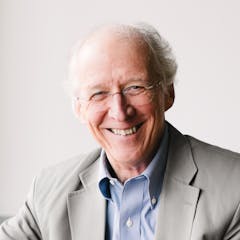
John Piper
@JohnPiper
The embrace may be only with the heart, or sometimes with physical arms, depending on proximity and the degree of the emotion. But in either case . . .
Gratitude embraces a person with glad affections for past good-will aimed at helping us.
and
Faith embraces a person with glad affections for future promises aimed at helping us.
Since every moment is the beginning of the rest of your life, and every moment is the end of the past, every moment should be governed by the glad affections of gratitude and faith.
Of course this is only possible if you see the world a certain way. If you see it the way biologist Richard Dawkins claims to see it you will not experience your moments this way. Dawkins sees the world as a naturalist, that is, without God: "Like successful Chicago gangsters our genes have survived . . . in a highly competitive world, . . . [and so] a predominant quality to be expected in a successful gene is ruthless selfishness. . . . We are survival machines - robot vehicles programmed to preserve the selfish molecules known as genes" (from his book The Selfish Gene, quoted in a review by Phillip Johnson, First Things, No. 97, Nov. 1999, p. 70).
If you see the world that way, there are no persons to embrace, but only biological machines; no personal affections to feel, but only genetic programming; no goodwill in the past and no promises for the future, but only ruthless, blind, genetic selfishness.
But if you see the world the way Gustav Oehler (German Lutheran professor of Old Testament at T|bingen, 1812-1872) sees it, you will experience your moments differently. Oehler said, "It is clear that the Old Testament teaches a providence which embraces everything. . . . No sphere of chance exists in the Old Testament. . . . Even what men call accidental death is under God's direction [Exodus 21:12-13]" (Theology of the Old Testament [Minneapolis, MN: Klock and Klock Christian Publishers, 1978], p. 122).
In this view of things, looking back is looking on the past providence of God: "As for you, you meant evil against me, but God meant it for good" (Genesis 50:20). And looking forward is looking on the future providence of God: "The mind of man plans his way, but the LORD directs his steps" (Proverbs 16:9). "Are not two sparrows sold for a cent? And yet not one of them will fall to the ground apart from your Father" (Matthew 10:29). "Surely goodness and mercy shall pursue me all the days of my life" (Psalm 23:6).
If you see the world in this biblical way - and if you stand inside that biblical world as your humbly-accepted world - then every moment will be a point of gratitude toward the past and faith toward the future. The practical implications of this are great. For example, gratitude is one of the humblest affections; and faith is one of the boldest affections. Just think what kind of people we would be in 2000 for the cause of Christ if we were continually humbled by our backward look of gratitude and continually emboldened by our forward look of faith! No, don't just think about it; pursue it - with all your mind and all your heart.
Pursuing with you,
Pastor John