Lenin, Francis and Paul …
Saint Francis left a legacy of delight and gratitude to God.
One reason we settle for such ordinary “soap opera” lives is because we have no heroes.
Baptists owe a lot to Zwingli when it comes to our doctrine of the Lord’s Supper.
A mind is not wasted when it is fully applied to the greatest challenge in the world.
A brief sketch on the life of Ralph Winter and his work with world missions.
John Piper quotes Spurgeon on how he came to believe in God's sovereign grace.
John Piper shares the surprising source of Spurgeon's first lessons in theology.
Joseph Alleine's life and writing was a true model of Puritan evangelism.
What sort of man was Martin Lloyd-Jones?
What kept William Carey going in the midst of great trial and loss?
It is worth noting that men of Edwards’ and Lloyd-Jones’ stature wrote and spoke so extensively about revival.
The life of David Brainerd is a bright testimony to the long-suffering, severe mercy of God.
Not many leaders today state the goals of their lives in terms of holiness.
The Bible, for Calvin, was above all a witness of God to the majesty of God. This led inevitably to what is the heart of Calvinism.
Find hope in the history of God's grace to help you live your life for his glory.
“Aurelius Augustine (354-430), Martin Luther (1483-1546), and John Calvin (1509-1564) had this in common: they experienced, and then built their lives and ministries on, the reality of God’s omnipotent grace” (p. 18).
“For John Bunyan, William Cowper, and David Brainerd, the loving purpose of God in pain was one of the most precious truths in the Bible and one of the most powerful experiences of their lives” (p. 25).
“Perseverance is a gift. That I will wake up and be a believer tomorrow morning is not finally and decisively owing to my will, but to God. I have known too many mornings on the precipice to think otherwise. That I have been snatched back every time is sheer mercy” (p. 22).
George Mueller's life is a testimony to the surpassing power that belongs to God and not to us.
Don't belittle God’s crooked sticks. With them he may write the message that makes a thousand people glad.
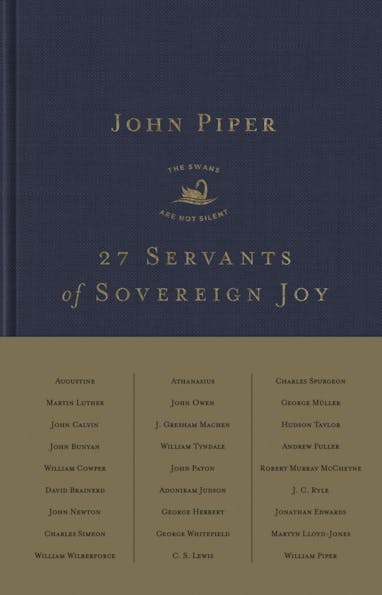
“Some swans are alive and sing in our day. But not many. And only time will tell if their song will survive the centuries. But time has already rendered that judgment for hundreds of swans. They have died, and their work has stood the test of time. Their song is, therefore, especially valuable for us to hear” (p. 9).
“In other words, offending God is the essential consideration, not killing man or imperiling a nation. That is what made Wilberforce tick. He was not a political pragmatist. He was a radically God-centered Christian who was a politician. And his true affections for God based on the ‘peculiar doctrines’ of Christianity were the roots of his endurance in the cause of justice” (p. 25).
The hardships in Lincoln's life drove him toward God, not away from him.
“The unhidden and unashamed aim in this book is to fan the flame of your passion for the centrality and supremacy of God” (p. 12).
"I am eager for people to know Calvin not because he was without flaws, or because he was the most influential theologian of the last 500 years (which he was), or because he shaped Western culture (which he did), but because he took the Bible so seriously, and because what he saw on every page was the majesty of God and the glory of Christ" (p. 9).
“What overwhelms me, as I ponder this and trace the lives of William Tyndale, John Paton, and Adoniram Judson, is how strategic it was that they died so many times and in so many ways before their lives on earth ended. This is no rhetorical flourish. The Bible speaks this way, and these followers of Christ knew it” (p. 13).
“At least two things have been burned on my mind with the help of John Calvin: the majesty of the Word of God—the Bible—and the supreme worth of the glory of God manifest above all in Jesus Christ” (p. 134).
"We are beggars — pray-ers. That is how we live, and that is how we study, so that God gets the glory and we get the grace" (p. 35).
John Piper introduces George Herbert, the Christian poet.
Joel Beeke provides a primer on the Puritans
In Episode 81, John Piper talks about the legacy of C. S. Lewis.
In Episode 82, John Piper talks about when he was first introduced to the works of C. S. Lewis.
In Episode 83, John Piper talks about how C. S. Lewis has influenced him.
In Episode 86, John Piper talks about how the writings of C. S. Lewis prepared him to understand and love the writings of Jonathan Edwards.
Philosophy of History Jonathan Edwards Old Testament Biblical Figures Poems